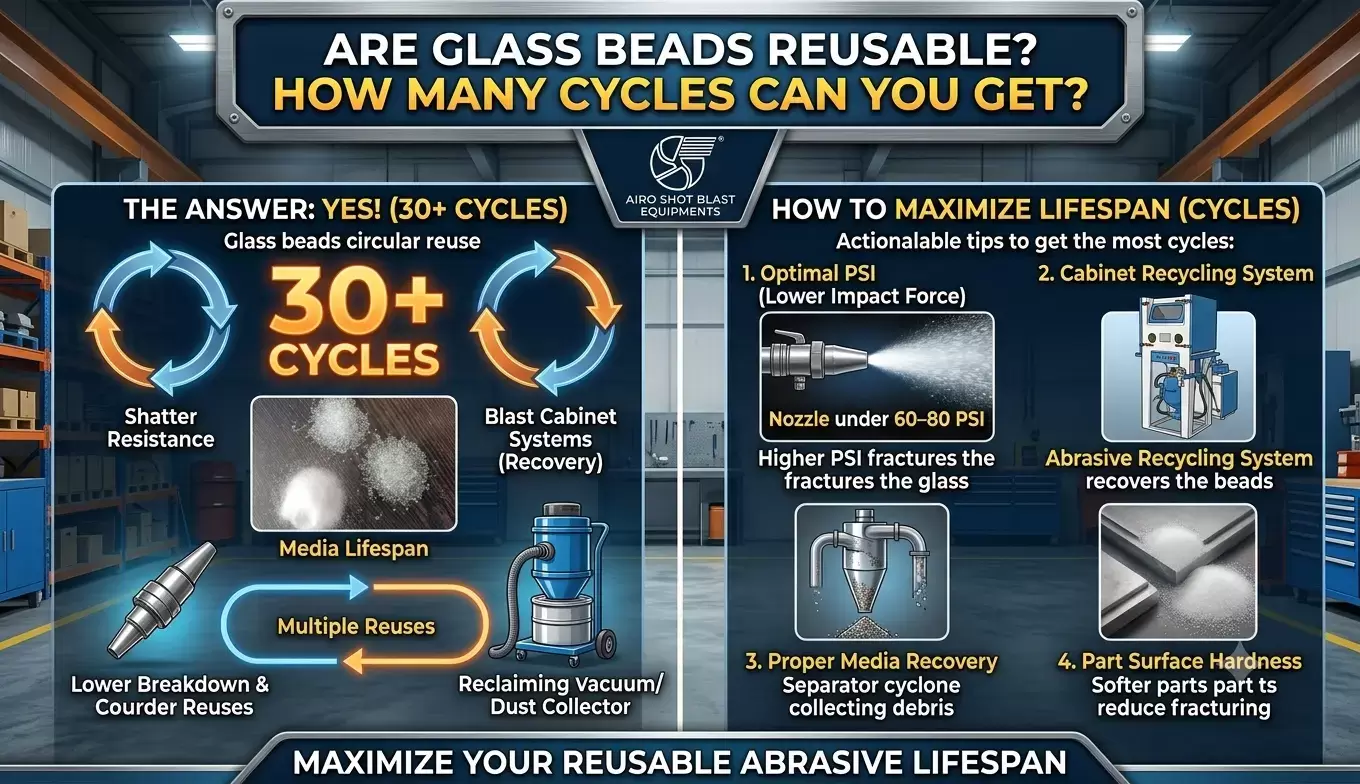
Generally, glass beads can be reused approximately 5-30 times, depending on their quality, size, blasting pressure, workpiece material, contamination level, and recovery system efficiency. This is an indicative operating range rather than a guaranteed number.
Glass bead blasting is a popular surface finishing technique used in automotive, aerospace, metal fabrication, manufacturing, and engineering industries. It helps remove surface contaminants, light rust, oxidation, and minor imperfections while producing a smooth, uniform, satin-like finish.
One of the biggest advantages of glass bead blasting is that the abrasive media can be reused multiple times. Unlike disposable blasting materials, glass beads can circulate through a blasting machine's recovery system and be used again after proper cleaning and separation.
But an important question for manufacturers is: Are glass beads reusable, and how many blasting cycles can they withstand before replacement?
In this article, we will explain how glass bead recycling works, what affects abrasive lifespan, when replacement is necessary, and how to maximize the number of reuse cycles.
Are Glass Beads Reusable?
Yes, glass beads are reusable abrasive media designed for repeated surface blasting applications.
They are manufactured from specially processed glass and have a spherical shape that helps produce a relatively smooth surface finish. During blasting, compressed air or a centrifugal wheel accelerates the beads toward the workpiece.
After impacting the surface, reusable beads are collected and passed through a recovery and separation system. This system removes dust, broken particles, paint residues, and other contaminants before returning suitable beads to the blasting machine.
However, glass beads gradually break down because of repeated impacts. Their spherical shape becomes damaged, and some particles fracture into smaller pieces.
Therefore, glass beads should only be reused while their particle size, cleanliness, and physical condition remain suitable for the required surface finish.
How Many Times Can Glass Beads Be Reused?
Glass beads can typically be reused around 5-30 cycles in a properly maintained blasting operation.
The actual number depends on several operating conditions.
|
Operating condition |
Effect on reuse cycles |
|---|---|
|
High-quality glass beads |
Generally improves durability |
|
Correct blasting pressure |
Helps reduce premature breakage |
|
Efficient media recovery |
Reduces abrasive loss |
|
Proper dust separation |
Maintains media cleanliness |
|
Excessive blasting pressure |
Can increase particle fracture |
|
Poor-quality abrasive |
May reduce service life |
|
Heavy contamination |
Can make media unsuitable sooner |
Fine and coarse micro glass beads may also behave differently depending on the blasting application. The abrasive grade, glass composition, and operating conditions all influence the actual lifespan.
Important: There is no universal reuse-cycle standard for all glass beads. The best way to determine usable life is through regular inspection, particle-size analysis, and monitoring of blasting performance.
A useful distinction from published blasting-media technical guides is that glass bead reuse estimates are often lower than estimates for steel shot. One industrial technical guide lists approximately 9-12 cycles, while another equipment manufacturer's guide lists 5-8 cycles. Some suppliers give lower estimates for demanding applications. These figures are more defensible planning references than assuming every glass bead batch will last 30 cycles.
How Does the Glass Bead Recycling Process Work?
Glass bead recycling takes place through a media recovery system installed in a blasting cabinet or industrial blasting machine.
The process generally includes five steps.
1. Collection of Used Glass Beads
After blasting, the glass beads fall into the cabinet's collection area. The recovery system collects reusable media along with dust, broken particles, and removed contaminants.
2. Transportation of Abrasive Media
A mechanical conveyor, vacuum recovery system, or pneumatic arrangement transfers the collected material to the separation unit.
3. Dust and Contaminant Separation
The separator removes fine dust, paint residues, rust particles, and other unwanted materials. Air-wash separators are commonly used to distinguish reusable abrasive from lighter contaminants.
4. Particle Size Classification
The recovered glass beads are screened or classified to remove undersized and broken particles. This is important because damaged beads can create an inconsistent surface finish.
5. Reuse in the Blasting Machine
Clean and properly sized glass beads return to the blasting hopper and are used again. This cycle continues until the abrasive no longer meets the required quality specifications.
An efficient recovery system helps reduce abrasive waste and maintain consistent blasting performance.
Factors That Affect the Reusability of Glass Beads
Several factors determine how many times glass bead blasting media can be recycled.
1. Glass Bead Quality
High-quality glass beads generally have consistent particle sizes, hardness, and spherical shapes. Better manufacturing quality helps maintain performance during repeated blasting operations.
2. Blasting Pressure
Operating pressure directly affects the impact energy of glass beads.
Excessive pressure can increase particle breakage and produce more dust. Using the appropriate pressure for the material and finishing requirement helps extend abrasive life.
3. Glass Bead Size
Different glass bead sizes are suitable for different applications. Fine beads are commonly selected for delicate finishing, while larger beads are used for general cleaning.
The particle size distribution should be monitored because repeated impacts gradually create smaller particles.
4. Workpiece Material
The type of material being blasted also affects abrasive consumption. Cleaning light surface contamination may cause less media deterioration than demanding operations involving heavy scale or stubborn deposits.
5. Recovery System Efficiency
A good abrasive recovery system separates broken glass, dust, and contaminants before they return to the blasting process.
Poor separation allows damaged particles to circulate repeatedly, affecting the surface quality and blasting efficiency.
6. Machine Maintenance
Regular inspection of sand blasting nozzles, air lines, recovery equipment, and dust collectors helps maintain stable operating conditions and reduce unnecessary media losses.
Signs That Glass Beads Need Replacement
Glass beads should not be reused indefinitely. Manufacturers should monitor abrasive condition and replace media when it no longer delivers the required results.
Common warning signs include:
- Excessive dust generation: An increase in fine glass particles may indicate abrasive breakdown.
- Broken or irregular beads: Fractured particles lose their original spherical shape.
- Poor surface finish: Components may develop inconsistent textures or unwanted scratches.
- Reduced cleaning performance: More blasting time may be required to achieve the same result.
- Changes in particle size: A significant increase in undersized particles indicates that the media is deteriorating.
- Higher abrasive consumption: Frequent additions of fresh glass beads may indicate excessive media loss or inefficient recovery.
Regular sieve analysis and visual inspection help determine when to replace the abrasive.
How to Increase Glass Bead Reuse Cycles
Manufacturers can improve glass bead lifespan by following these practical recommendations:
- Use high-quality glass beads: Select consistent abrasive media from a reliable manufacturer.
- Maintain correct air pressure: Avoid unnecessarily high blasting pressure.
- Install an efficient separator: Remove broken particles and contaminants before reuse.
- Monitor particle size: Perform regular sieve testing to maintain the correct abrasive distribution.
- Clean the blasting cabinet: Prevent dust and debris from contaminating reusable media.
- Maintain blasting equipment: Inspect the nozzle, hoses, recovery system, and dust collector.
- Avoid mixing different media grades: Mixing particle sizes can produce inconsistent finishing results.
These practices can help improve abrasive utilization, reduce replacement costs, and maintain consistent surface quality.
Glass Beads vs. Other Blasting Media: Reuse Cycle Comparison
Different abrasive materials offer different recycling capabilities.
|
Abrasive media |
Indicative reuse cycles |
|---|---|
|
Glass beads |
5-12 |
|
Garnet |
3-5 |
|
Aluminum oxide |
10-12 |
|
Silicon carbide |
9-10 |
|
Plastic media |
7-9 |
|
Steel shot and steel grit |
80-100 |
These are indicative figures from an industrial abrasive technical guide, not universal guarantees. Actual service life varies with equipment, media quality, and operating conditions.
Glass beads are particularly useful when a smooth, uniform finish is more important than aggressive material removal. Steel shot and grit generally offer substantially longer recycling life in suitable closed-loop blasting systems.
Benefits of Reusing Glass Bead Blasting Media
Recycling glass beads offers several advantages for industrial manufacturers.
- Lower operating costs: Reduces the need to purchase fresh abrasive after every blasting operation.
- Less material waste: Allows usable glass beads to remain in circulation.
- Consistent finishing: Properly classified media helps maintain uniform surface quality.
- Improved productivity: Reduces interruptions caused by frequent abrasive replacement.
- Better resource utilization: Makes industrial blasting operations more economical and efficient.
Conclusion
Yes, glass beads are reusable and can be recycled multiple times in properly maintained blasting equipment. In many industrial applications, their typical service life is approximately 5-12 cycles, although actual performance depends on glass bead quality, blasting pressure, workpiece material, and recovery system efficiency.
An effective abrasive recovery system, regular particle-size inspection, and proper machine maintenance are essential for maximizing glass bead reuse cycles.
For manufacturers involved in stainless steel finishing, aluminum cleaning, automotive component finishing, and precision surface treatment, glass bead recycling offers an effective way to reduce abrasive consumption while maintaining consistent surface quality.
The key is not simply to reuse glass beads as many times as possible, but to maintain their quality throughout the recycling process.