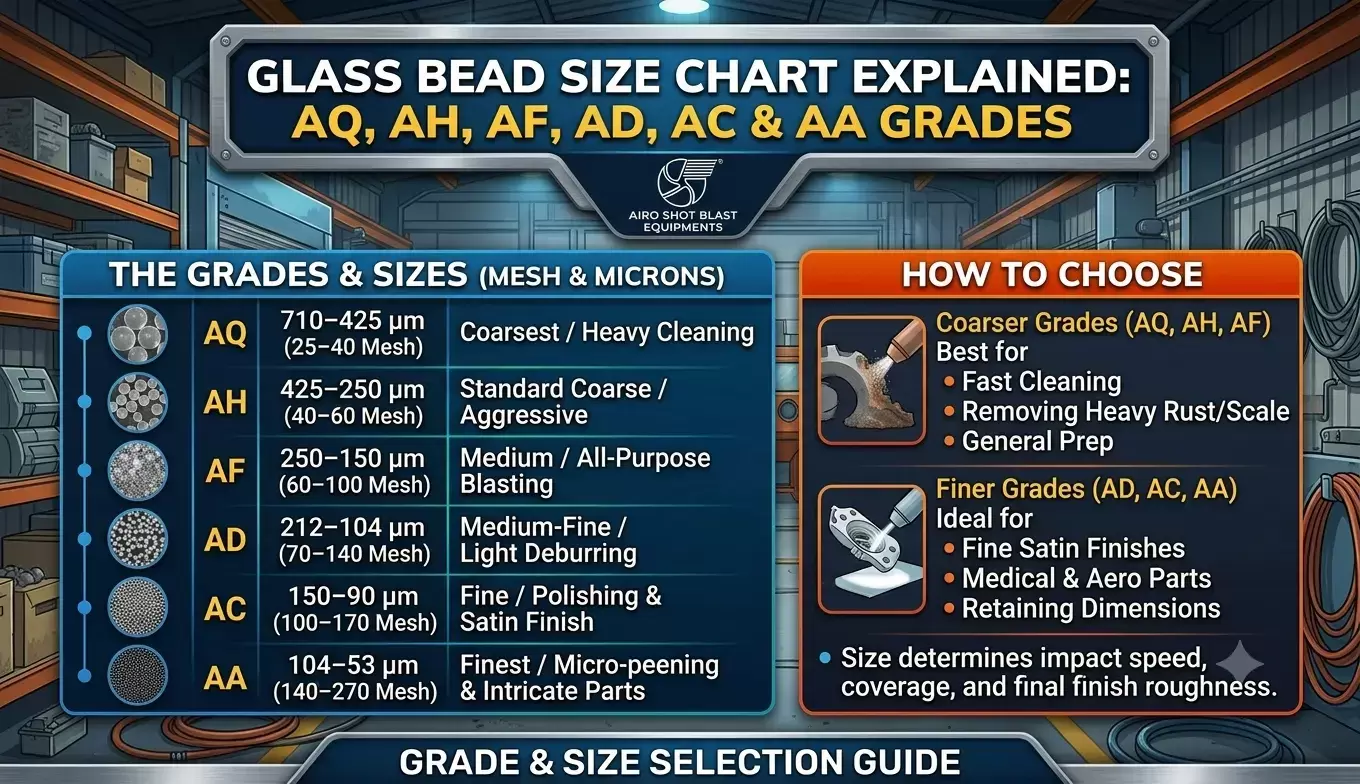
Among the commonly used glass bead classifications are AQ, AH, AF, AD, AC, and AA grades. Understanding these grades helps manufacturers select suitable abrasive media, improve blasting efficiency, and achieve consistent surface finishing results.
However, achieving the desired surface finish depends heavily on selecting the correct glass bead size. Different glass bead grades are designed for different applications, ranging from fine surface polishing to aggressive cleaning and removal of surface contaminants.
Glass beads blasting is widely used in manufacturing, automotive, aerospace, metal fabrication, and surface finishing industries. It is an effective method for cleaning, polishing, deburring, and improving the appearance of metal components without causing excessive material removal.
In this guide, we explain the glass bead size chart, the differences between glass bead size AQ, AH, AF, AD, AC, and glass beads AA grades, their applications, and how to select the right glass bead size for your blasting requirements.
What Is a Glass Bead Size Chart?
A glass bead size chart is a reference guide that classifies glass blasting media according to particle size and grading specifications.
Glass beads are manufactured from specially processed glass and shaped into small spherical particles. These particles are available in different sizes to meet various industrial surface treatment requirements.
The size of glass beads directly affects:
- Surface roughness and texture
- Cleaning and polishing performance
- Blasting speed and efficiency
- Surface appearance
- Abrasive consumption
- Suitability for delicate or heavy-duty components
Small glass beads generally produce a finer, smoother finish, whereas larger beads provide greater impact energy per particle and are often selected for more demanding cleaning applications.
Glass Bead Size Chart: AQ, AH, AF, AD, AC and AA Grades
The glass bead AQ, AH, AF, AD, AC, and AA classifications are used in certain commercial glass bead grading systems. However, these letter codes are not universally standardized across all manufacturers. Their exact particle-size ranges should always be verified against the supplier's technical datasheet.
The following table explains the grades and their general selection considerations.
|
Glass bead grade |
General size positioning |
Typical application |
|---|---|---|
|
AQ |
Fine grade |
Fine cleaning and finishing |
|
AH |
Fine-to-medium grade |
General surface finishing |
|
AF |
Medium grade |
Cleaning and satin finishing |
|
AD |
Medium-to-coarse grade |
General industrial cleaning |
|
AC |
Coarse grade |
Heavier surface cleaning |
|
AA |
Coarse-to-large grade |
More demanding cleaning applications |
Important: This is a general application-oriented guide, not a verified micron or mesh conversion chart. Grade codes can differ between manufacturers. Always confirm the actual particle-size range before purchasing.
What Are the Different Glass Bead Grades?
Each glass bead grade is designed for a particular surface finishing requirement. Understanding the differences makes it easier to select the right abrasive for industrial blasting.
1. AA Grade Glass Beads (40–70 Mesh)
AA is a relatively coarse glass bead grade, generally ranging from 212 to 425 microns.
Applications:
- General metal surface cleaning
- Removal of light rust and oxidation
- Cleaning industrial components
- Surface preparation before further finishing
AA grade is suitable when a relatively strong cleaning action is required without using highly aggressive angular abrasives.
2. AC Grade Glass Beads (60–120 Mesh)
Glass bead size AC generally ranges from 125 to 250 microns.
Applications:
- Stainless steel surface finishing
- Cleaning aluminum components
- Removing surface stains and light contaminants
- Producing uniform satin finishes
AC grade provides a useful balance between cleaning performance and surface smoothness.
3. AD Grade Glass Beads (70–140 Mesh)
AD grade glass beads generally fall within the 106-212 micron range.
Applications:
- Stainless steel finishing
- Cleaning precision-machined components
- Removing minor surface imperfections
- Decorative metal finishing
AD grade is commonly considered when a smoother and more refined surface appearance is required.
4. AF Grade Glass Beads (100–200 Mesh)
Glass bead size AF grade is a fine glass bead abrasive, with an approximate particle size of 75–150 microns.
Applications:
- Fine surface cleaning
- Aluminum component finishing
- Automotive parts
- Precision metal components
- Smooth cosmetic finishing
AF grade is useful for applications where manufacturers want to clean surfaces while maintaining a relatively fine and consistent texture.
5. AH Grade Glass Beads (170–325 Mesh)
AH grade is a very fine abrasive, generally ranging from 45 to 90 microns.
Applications:
- Fine polishing and finishing
- Delicate metal components
- Precision cleaning
- Medical equipment components
- Fine surface treatment
Its smaller particle size makes it suitable for applications requiring controlled, gentle surface finishing.
6. AQ Grade Glass Beads (325 Mesh and Finer)
AQ is an extra-fine glass bead grade, typically consisting of particles approximately 44 microns and smaller.
Applications:
- Extra-fine surface finishing
- Delicate component cleaning
- Specialized polishing operations
- Applications requiring minimal surface alteration
Glass beads size AQ grade is suitable for specialized finishing requirements where very fine abrasive particles are preferred.
Correct Glass Bead Size Chart in Microns and Mesh
For industrial purchasing and blasting applications, the following commercial grade classifications are a useful reference:
|
Grade |
Mesh size |
Approx. particle size |
Classification |
|---|---|---|---|
|
AA |
40–70 |
212-425 microns |
Coarse |
|
AC |
60–120 |
125-250 microns |
Medium |
|
AD |
70–140 |
106-212 microns |
Medium-fine |
|
AF |
100–200 |
75-150 microns |
Fine |
|
AH |
170–325 |
45-90 microns |
Very fine |
|
AQ |
325 and finer |
44 microns and below |
Extra fine |
Note: Particle-size ranges are approximate and presented in ascending order for clarity. Commercial specifications and sieve tolerances may vary by manufacturer.
Understanding the grading: Mesh numbers indicate the number of openings per linear inch in a sieve. A higher mesh number generally indicates smaller particles. Micron measurements provide a more direct indication of particle size.
How to Choose the Right Glass Bead Size?
Selecting the correct glass bead size is essential for achieving the required surface finish and maintaining production efficiency.
Consider these important factors before choosing a grade:
- Material type: Stainless steel, aluminum, brass, and titanium may require different bead sizes and blasting parameters.
- Required surface finish: Choose coarser grades for general cleaning and finer grades for smoother cosmetic finishes.
- Surface contamination: Light stains and oxidation may require different media sizes than heavier contaminants.
- Component dimensions: Delicate and precision-machined components generally require more controlled blasting conditions.
- Blasting equipment: Consider whether the machine uses a suction-feed or pressure-feed system and whether it can handle the selected particle size.
- Production requirements: Evaluate cleaning speed, abrasive consumption, media recovery, and the consistency of the final finish.
Always conduct a sample blasting test before finalizing the abrasive grade for large-scale production.
Benefits of Selecting the Correct Glass Bead Grade
Choosing the right glass bead size offers several advantages:
- Better surface finish: Helps achieve consistent cleaning and finishing results.
- Improved productivity: Suitable media can reduce unnecessary blasting time.
- Controlled material removal: Spherical glass beads are generally less aggressive than angular abrasives.
- Better appearance: Helps produce clean, uniform satin or matte finishes.
- Reduced rework: Correct abrasive selection improves finishing consistency.
- Efficient media utilization: Appropriate operating conditions can support multiple reuse cycles.
Common Industrial Applications of Glass Bead Blasting
Glass bead blasting is used across several industries because of its controlled cleaning and finishing capabilities.
| Industry | Typical applications |
|---|---|
| Automotive | Engine parts, aluminum components and metal brackets |
| Aerospace | Selected precision components and turbine parts |
| Medical | Stainless steel instruments and equipment |
| Metal fabrication | Stainless steel sheets, fittings and fabricated parts |
| Marine | Metal fittings and compatible hardware |
| Manufacturing | Machined components, deburring and surface cleaning |
Conclusion
Understanding the glass bead size chart is essential for selecting the right abrasive media for industrial surface finishing. AQ, AH, AF, AD, AC, and AA grades offer different particle-size ranges and are suitable for different cleaning, polishing, and finishing applications.
While AA and AC grades are useful for general cleaning and surface preparation, AD and AF provide options for finer finishing. Glass bead size AH and AQ are suitable for applications requiring smaller abrasive particles and more delicate surface treatment.
Before purchasing glass bead blasting media, always check the manufacturer's mesh specifications, micron range, particle shape, and technical datasheet.
Choosing the correct glass bead grade can improve surface quality, optimize blasting performance, reduce unnecessary abrasive consumption, and deliver more consistent industrial finishing results.