
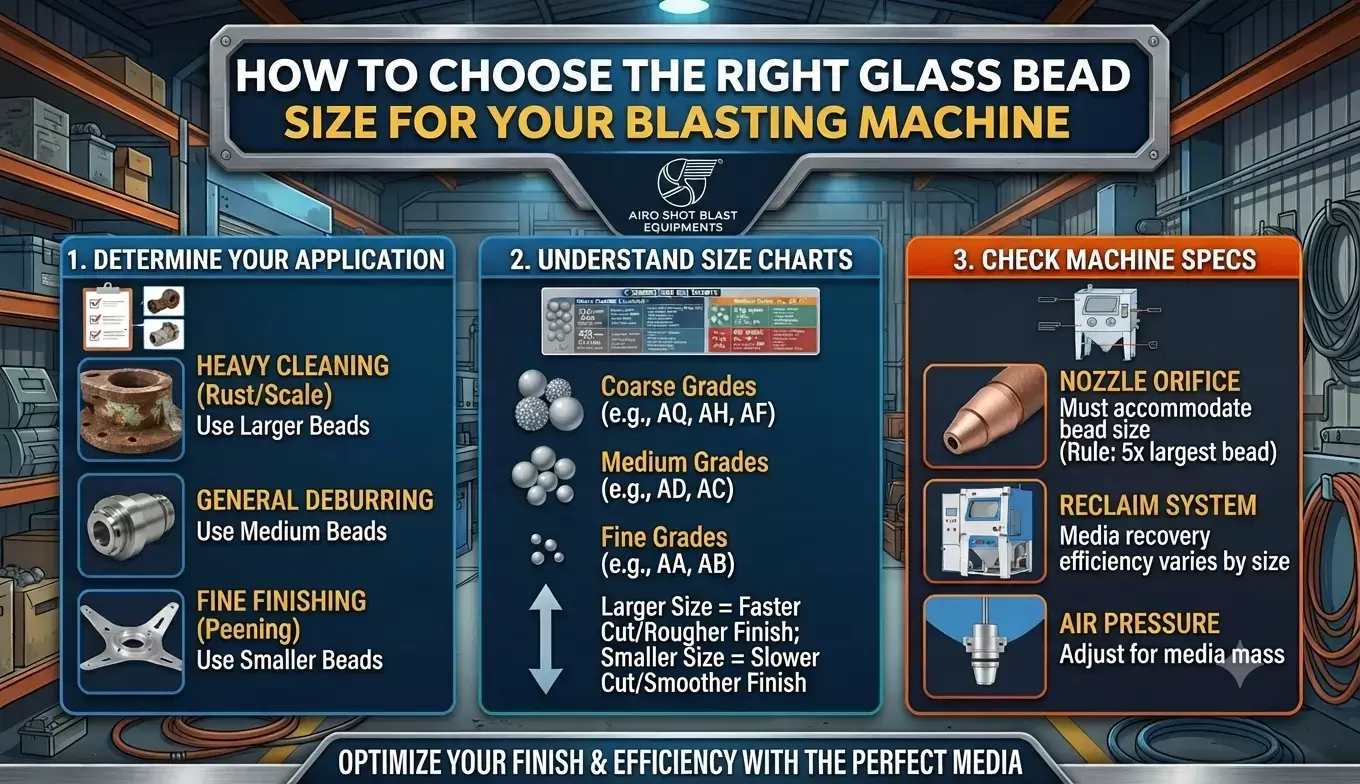
Glass bead blasting is a widely used surface finishing process in industries such as automotive, aerospace, metal fabrication, manufacturing, and engineering. It helps remove dirt, light rust, oxidation, and surface imperfections while producing a smooth, clean, and uniform satin finish.
However, achieving the desired results depends on selecting the correct glass bead size for your blasting machine. Using the wrong abrasive size can lead to inconsistent surface finishing, reduced cleaning efficiency, increased media consumption, and unnecessary operating costs.
Glass beads are available in different grades, mesh sizes, and micron ranges to meet various industrial requirements. Therefore, understanding how to choose the right glass bead size is essential for achieving better blasting performance.
In this guide, we explain the important factors to consider when selecting glass bead blasting media, different bead sizes, their applications, and how to match abrasive size with your machine and surface finishing requirements.
1. Understand Different Glass Bead Sizes
Glass beads are spherical abrasive particles manufactured from specially processed glass. They are available in different particle sizes, ranging from very fine to coarse grades.
The size of glass beads directly affects their impact characteristics, cleaning efficiency, and final surface appearance.
- Fine glass beads: Suitable for delicate components, fine cleaning, and smooth surface finishing.
- Micro glass beads: Ideal for general industrial cleaning and satin finishing.
- Coarse glass beads: Useful for applications requiring stronger cleaning action and more noticeable surface texture.
Smaller particles generally produce a finer finish, while larger particles deliver greater impact energy per particle under comparable conditions.
2. Check the Glass Bead Size Chart
Before purchasing abrasive media, review the manufacturer's glass bead size chart. It normally provides particle-size measurements in microns and mesh.
The following table provides an illustrative classification of commonly marketed glass bead size chart AQ, AH, AF, AD, AC, and AA grades.
| Glass bead grade | Approximate particle size | Typical application |
|---|---|---|
| AQ | 44 microns and below | Extra-fine finishing |
| AH | 45–90 microns | Fine surface treatment |
| AF | 75–150 microns | Precision cleaning |
| AD | 106–212 microns | General finishing |
| AC | 125–250 microns | Industrial cleaning |
| AA | 212–425 microns | Coarser cleaning |
Important: These grade codes and size ranges are illustrative commercial classifications, not universal industry standards. Actual specifications vary between manufacturers. Always check the technical datasheet before ordering.
3. Consider the Material Being Blasted
The workpiece material is one of the most important factors when choosing glass bead size.
Different materials have different hardness levels, surface characteristics, and finishing requirements.
- Stainless steel: Medium and fine glass beads are commonly used to create a uniform satin finish and remove light surface contamination.
- Aluminum: Fine or medium glass beads are often preferred because aluminum is relatively soft and can be damaged by excessive blasting intensity.
- Brass and copper: Fine glass beads can help clean and improve the appearance of these softer metals.
- Titanium: Carefully selected glass bead sizes and controlled blasting parameters are important for precision finishing applications.
- Plastic components: Glass bead blasting may be suitable for certain compatible plastics, but pressure and particle size must be carefully controlled to avoid surface damage.
Always perform a sample test before starting full-scale production.
4. Match Glass Bead Size with Your Surface Finishing Requirement
The desired surface finish should guide your abrasive selection.
| Finishing requirement | Suggested bead size |
|---|---|
| Delicate cleaning | Fine |
| Smooth satin finish | Fine to medium |
| General metal cleaning | Medium |
| Removal of light oxidation | Medium |
| More noticeable surface texture | Medium to coarse |
| Precision component finishing | Fine |
Remember that glass beads are relatively mild abrasives. They are not the best choice for removing heavy rust, thick coatings, or deep mill scale. More aggressive media may be required for those applications.
5. Check Your Blasting Machine Specifications
Not every glass bead size is suitable for every blasting machine. Before selecting abrasive media, understand your machine's operating requirements.
Important parameters include:
- Sand blasting nozzle diameter
- Available compressed air pressure
- Air consumption
- Blast cabinet design
- Abrasive recovery system
- Media separator capacity
- Manufacturer-recommended abrasive size
For example, very fine glass beads may require an effective dust collection and separation system to prevent excessive media loss. Larger particles may require suitable nozzle and recovery arrangements.
Always follow the machine manufacturer's recommendations.
6. Select the Correct Blasting Pressure
Blasting pressure plays an important role in determining the impact force of glass beads.
Higher pressure can increase cleaning intensity, but it may also cause premature bead breakage, excessive dust, or surface damage.
Lower pressure provides a gentler treatment and may be more appropriate for delicate components.
The correct pressure depends on:
- Glass bead size
- Workpiece material
- Desired surface finish
- Nozzle distance
- Blasting angle
- Component thickness
Start with the equipment manufacturer's recommended settings and adjust them through controlled testing.
7. Consider Glass Bead Quality and Reusability
Selecting the right particle size is important, but abrasive quality is equally essential.
High-quality large glass beads should have consistent spherical shapes, suitable hardness, controlled particle-size distribution, and minimal contamination.
Poor-quality glass beads may break quickly, generate excessive dust, and create uneven surface finishes.
Before purchasing, check:
- Particle-size distribution
- Sphericity and roundness
- Hardness
- Chemical composition
- Broken particle percentage
- Manufacturer's quality inspection report
Glass beads can be recycled through suitable blasting systems, but their usable life depends on media quality, operating pressure, and recovery efficiency.
8. Avoid Common Glass Bead Selection Mistakes
Manufacturers sometimes experience poor blasting results because of incorrect abrasive selection.
Here are some mistakes to avoid:
- Choosing bead size based only on price.
- Ignoring the material hardness of the workpiece.
- Using coarse beads on delicate components without testing.
- Applying excessive blasting pressure.
- Mixing different glass bead grades without evaluating the resulting particle distribution.
- Ignoring the machine's abrasive recovery capacity.
- Failing to inspect recycled glass beads regularly.
Avoiding these mistakes can improve surface quality and reduce unnecessary abrasive consumption.
9. Benefits of Choosing the Right Glass Bead Size
Selecting the appropriate glass bead size offers several advantages:
- Consistent surface finish: Produces uniform cleaning and finishing results.
- Better productivity: Reduces unnecessary blasting time.
- Controlled surface treatment: Helps prevent excessive material removal.
- Lower operating costs: Reduces abrasive waste and rework.
- Improved component appearance: Creates a clean, professional finish.
- Better media utilization: Helps maintain effective abrasive recycling.
Conclusion
Choosing the right glass bead size for your blasting machine is essential for achieving consistent surface finishing, improving production efficiency, and controlling abrasive consumption.
Before selecting glass bead blasting media, consider the workpiece material, required surface finish, particle-size specifications, machine capacity, and operating pressure.
We are the leading glass bead manufacturers in India. Fine glass beads are generally suitable for delicate cleaning and precision finishing, while medium and coarse grades are more appropriate for general cleaning and stronger surface treatment.
Most importantly, always verify the manufacturer's glass bead size chart and conduct a sample blasting test before purchasing abrasive media in bulk.
The right combination of glass bead size, quality, and machine settings can help manufacturers achieve better finishing results and more efficient industrial blasting operations.