Glass beads are widely used in industrial surface finishing, abrasive blasting, automotive manufacturing, aerospace, metal fabrication, and other engineering applications. They help clean metal surfaces, remove light contaminants, improve surface appearance, and produce a smooth, uniform satin finish.
However, the quality of glass beads can vary significantly between manufacturers and suppliers. Differences in particle size, roundness, hardness, chemical composition, and manufacturing quality can directly affect blasting performance and the final surface finish.
Choosing the right glass beads supplier is therefore an important decision for glass bead manufacturers looking to maintain product quality, control operating costs, and achieve consistent production results.
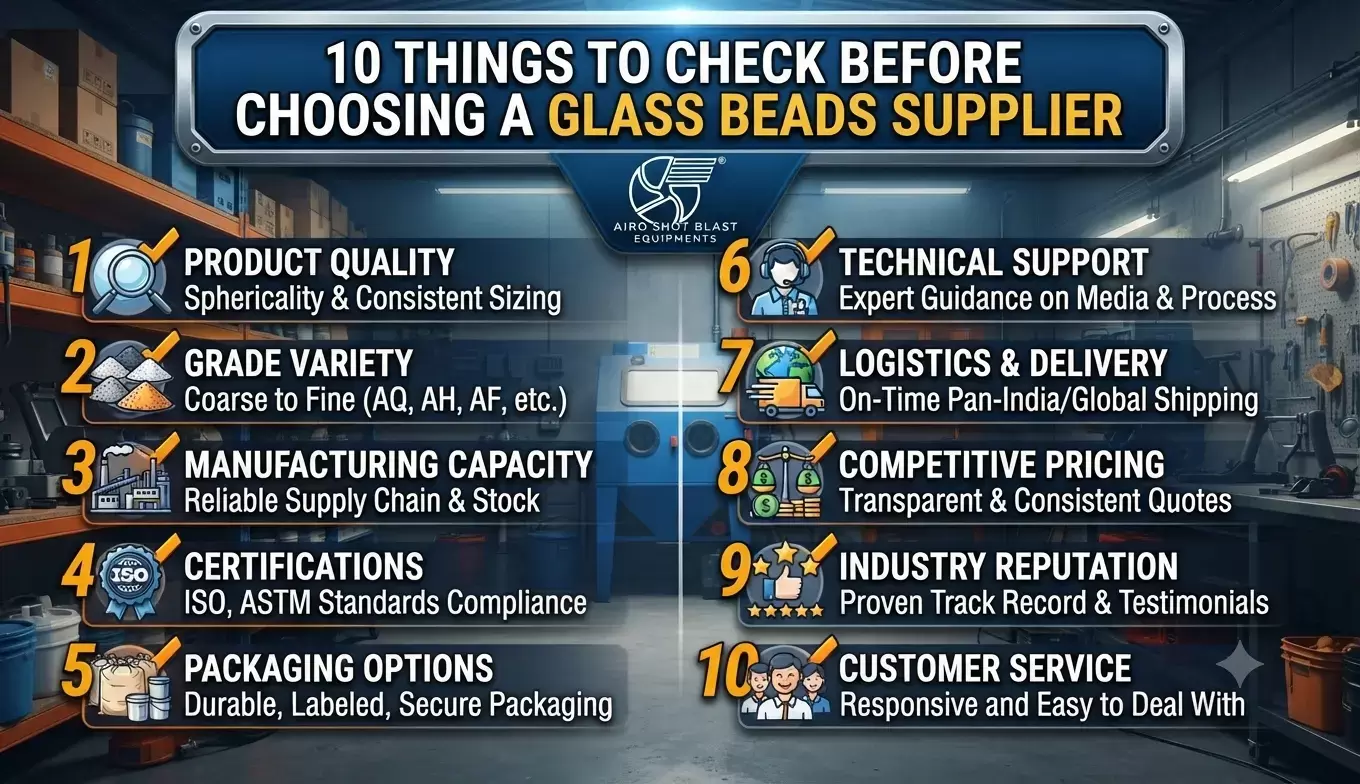
Whether you need glass beads for stainless steel finishing, aluminum cleaning, precision component treatment, or industrial sandblasting, here are 10 important things to check before selecting a reliable glass beads manufacturer or supplier.
1. Check the Quality of Glass Beads
Product quality should be your first consideration when choosing a glass beads supplier. High-quality glass beads should have a consistent spherical shape, smooth surface, and minimal broken or irregular particles.
Poor-quality glass beads may break quickly during blasting, generate excessive dust, and produce inconsistent surface finishes.
Before placing an order, check:
- Particle shape and roundness
- Hardness and durability
- Surface cleanliness
- Broken particle percentage
- Uniformity of glass bead composition
A reliable supplier should be able to provide product samples and supporting quality inspection reports.
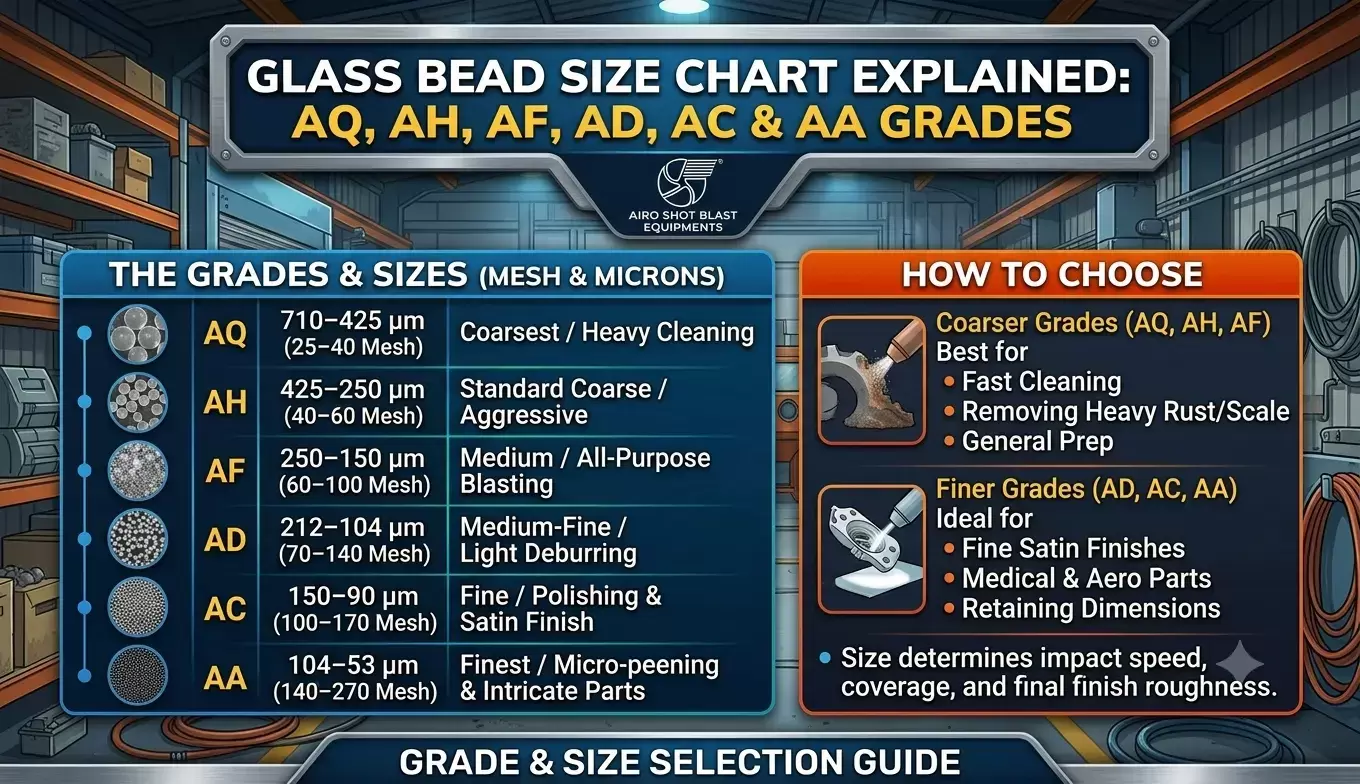
2. Check Glass Bead Size and Grade Availability
Different industrial applications require different glass bead sizes. A supplier should offer multiple particle-size grades to meet specific blasting and finishing requirements.
Common glass bead grades include glass bead size AQ, AH, AF, AD, AC, and AA in certain commercial grading systems. However, these classifications can vary between manufacturers.
Check whether the supplier provides:
- Fine glass beads for precision finishing
- Medium-sized glass beads for general cleaning
- Coarse glass beads for heavier cleaning applications
- Custom micron and mesh-size specifications
Ask for a detailed glass bead size chart showing the actual particle-size distribution in microns and mesh.
3. Verify Manufacturing Standards and Certifications
Certifications and technical standards help buyers evaluate a supplier's quality management system and product suitability.
For industrial glass bead blasting, check whether the supplier can demonstrate compliance with relevant product specifications, such as SAE AMS 2431/6 or MIL-PRF-9954D, where applicable.
Also consider checking:
- ISO 9001 quality management certification
- Product-specific compliance documentation
- Material test reports
- Quality inspection procedures
- Safety Data Sheets (SDS)
Remember that ISO 9001 certifies a quality management system, not the performance of every glass bead batch. Always verify that certificates are valid and cover the relevant manufacturing facility and product.
4. Ask for Consistent Batch-to-Batch Quality
Consistency is essential for industrial blasting operations. If the glass bead quality changes between deliveries, manufacturers may experience variations in surface finish, abrasive consumption, and production efficiency.
A dependable glass bead supplier should maintain consistent specifications across different production batches.
Ask for:
- Batch-wise quality inspection reports
- Sieve analysis reports
- Particle-size distribution data
- Hardness test results
- Batch identification and traceability
Checking these parameters helps ensure that every delivery meets your required specifications.
5. Check the Supplier's Manufacturing Capacity
Before selecting a glass beads manufacturer, evaluate its production capacity and ability to fulfil your regular requirements.
A supplier with limited production capacity may struggle to handle bulk orders or maintain consistent delivery schedules.
Important factors include:
- Monthly and annual production capacity
- Availability of different glass bead grades
- Manufacturing equipment and technology
- Quality control facilities
- Ability to handle customized orders
- Experience in industrial supply
If your business requires large quantities of glass beads regularly, consider working directly with a manufacturer that can support long-term supply agreements.
6. Evaluate Pricing and Overall Cost
Price is an important factor when purchasing industrial glass beads, but choosing the cheapest supplier is not always economical.
Low-cost glass beads may have inconsistent particle sizes, higher breakage rates, or excessive impurities. These problems can increase abrasive consumption and operating expenses.
Compare suppliers based on:
- Glass beads price per kg or metric ton
- Product quality and specifications
- Packaging and transportation charges
- Expected abrasive consumption
- Delivery costs
- Long-term supply reliability
Instead of comparing only the purchase price, calculate the total cost of using the abrasive in your blasting operation.
7. Check Packaging and Storage Conditions
Glass beads must be properly packed and stored to maintain their quality during transportation and warehousing.
Poor packaging can expose the abrasive to moisture, contamination, and physical damage.
A professional glass bead supplier should provide:
- Moisture-resistant packaging
- Strong and properly sealed bags
- Clearly printed product labels
- Batch numbers and manufacturing details
- Accurate net weight information
- Safe bulk packaging options
Common packaging options include 25 kg bags and jumbo bags, depending on the supplier and order quantity.
Proper storage in a clean, dry environment also helps prevent contamination and moisture-related handling problems.
8. Ask About Product Testing and Quality Control
A reliable glass beads manufacturer should have a proper quality control system to inspect products before dispatch.
Testing helps verify whether the supplied large glass beads meet the required technical specifications.
Important quality parameters include:
- Particle-size distribution: Confirms whether the beads meet the specified micron or mesh range.
- Sphericity: Checks the percentage of properly rounded particles.
- Hardness: Helps evaluate resistance to repeated impact.
- Chemical composition: Provides information about the glass material.
- Contamination: Checks for unwanted foreign particles and impurities.
- Bulk density: Helps evaluate material consistency and handling characteristics.
Ask for a Certificate of Analysis (COA) or batch-specific test report before purchasing in bulk. For critical applications, consider independent laboratory testing.
9. Evaluate Delivery Time and Customer Support
A supplier's responsibility does not end after accepting an order. Reliable delivery and responsive customer support are equally important for maintaining uninterrupted production.
Before finalizing your supplier, check:
- Standard order processing time
- Delivery schedules
- Bulk order handling capabilities
- Availability of ready stock
- Export and transportation experience
- Response time for technical queries
- Replacement and complaint policies
A good supplier should also help you select the appropriate glass bead grade based on your blasting machine, workpiece material, and required surface finish.
10. Check Industry Experience and Customer Reputation
Experience is another important factor when choosing a glass beads supplier. A manufacturer with industry experience is generally better positioned to understand different abrasive blasting requirements.
Before making a final decision, evaluate:
- Years of experience in glass bead manufacturing
- Industries and applications served
- Existing customer relationships
- Product range and technical expertise
- Customer reviews and references
- History of product quality and delivery performance
You can also request samples and conduct a trial blasting operation before committing to a long-term purchasing agreement.
Why Choosing the Right Glass Beads Supplier Matters
Selecting the right supplier offers several long-term benefits for industrial manufacturers.
- Consistent surface finishing: Quality glass beads help achieve uniform cleaning and finishing results.
- Reduced abrasive consumption: Durable and properly manufactured beads can reduce premature breakage and unnecessary replacement.
- Lower operating costs: Consistent media quality helps minimize production delays, rework, and abrasive waste.
- Improved productivity: Reliable product availability supports continuous blasting operations.
- Better technical support: Experienced suppliers can recommend suitable grades, sizes, and operating parameters for specific applications.
Ultimately, the right supplier contributes to better product quality and more efficient manufacturing operations.
Conclusion
Choosing a reliable glass beads supplier requires more than comparing prices. Manufacturers should carefully evaluate product quality, particle-size availability, certifications, batch consistency, production capacity, pricing, packaging, testing facilities, delivery reliability, and industry experience.
A supplier that offers consistent product quality, proper technical documentation, competitive pricing, and dependable customer support can become a valuable long-term business partner.
Before placing a bulk order, always request product samples, review the technical datasheet, verify quality certificates, and conduct a practical blasting test.
Taking these steps will help you select the right glass beads manufacturer and ensure better surface finishing performance, reduced operating costs, and reliable industrial production.