Glass Beads for Shot Peening
In modern manufacturing, component durability and resistance to repeated loading are essential for ensuring long-term performance. Industries such as automotive, aerospace, engineering, and heavy machinery rely on surface treatment processes to improve the strength and service life of critical metal components. One effective technique is shot peening using glass beads.
Glass bead shot peening is a controlled surface treatment process that uses spherical glass beads to create beneficial compressive residual stresses on a component's surface. These stresses help reduce the risk of fatigue crack initiation and propagation, improving resistance to cyclic loading when the process is properly designed and controlled.
In this blog, we will explore how glass beads for shot peening work, their benefits, applications, and how they contribute to improving metal fatigue life.
1. What Is Glass Bead Shot Peening?
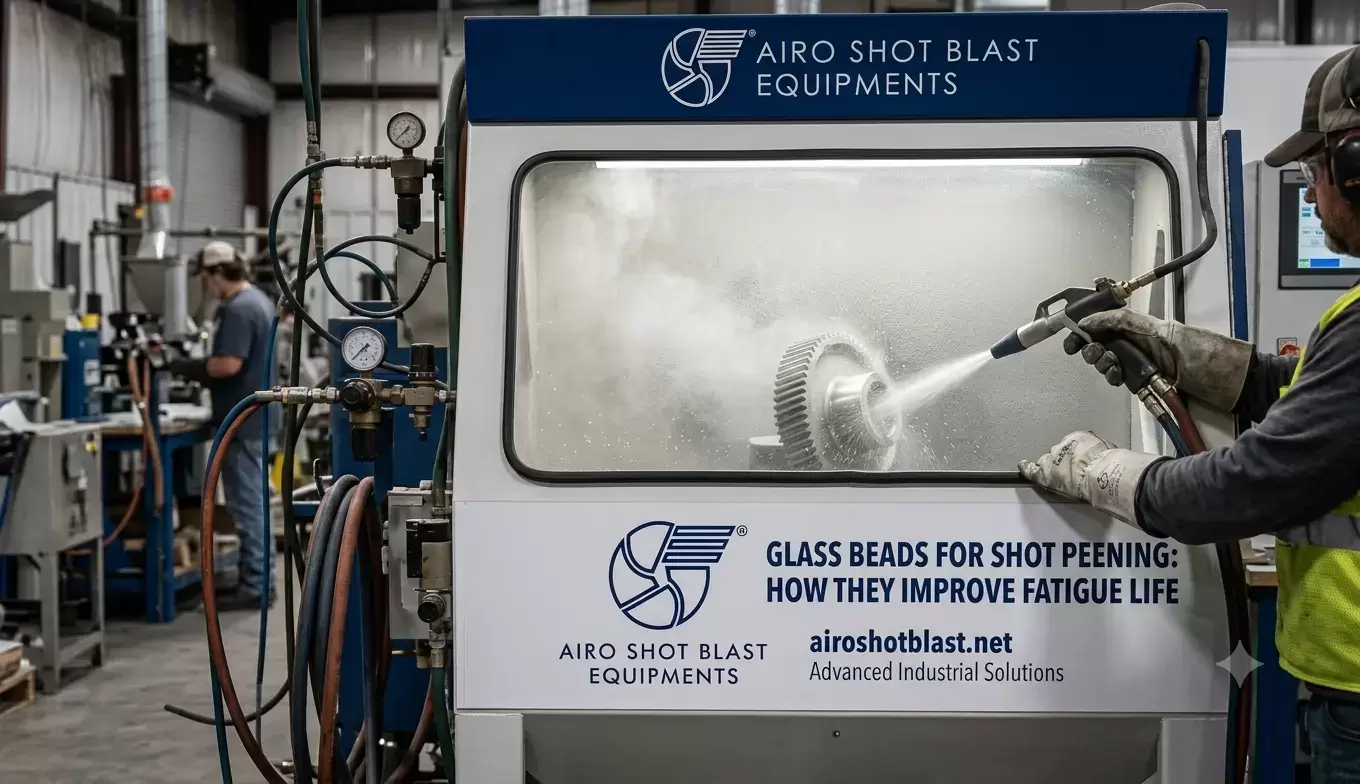
Glass bead shot peening is a mechanical surface treatment process in which small spherical glass particles are propelled at a metal surface using compressed air or specialized blasting equipment.
When the reflective glass beads strike the component, they produce tiny, controlled indentations. This localized plastic deformation can generate compressive residual stresses near the surface.
These compressive stresses help counteract tensile stresses that commonly contribute to fatigue crack formation.
Unlike conventional abrasive blasting, which primarily focuses on cleaning or removing surface material, shot peening is designed to improve the mechanical performance of components through controlled surface deformation.
Glass bead shot peening is particularly useful when a relatively clean, uniform surface texture and controlled impact treatment are required.
2. How Shot Peening Improves Metal Fatigue Life
Metal fatigue occurs when a component experiences repeated or fluctuating loads over time. Even when the applied load is below the material's ultimate tensile strength, repeated stress cycles can eventually initiate cracks and cause failure.
Shot peening helps address this problem by introducing compressive residual stresses into the surface layer.
The process works in the following way:
- Spherical glass beads impact the metal surface.
- Each impact creates a small area of localized plastic deformation.
- Surrounding material constrains the deformed surface layer.
- This creates compressive residual stresses near the surface.
- These stresses help reduce the effective tensile stress experienced during service.
As a result, fatigue cracks may take longer to initiate and propagate.
Important: The improvement in fatigue life depends on the material, component geometry, applied loading, bead properties, and process parameters. It should be validated through appropriate testing rather than assumed for every application.
3. Key Benefits of Using Glass Beads for Shot Peening
Glass bead shot peening offers several potential advantages for industrial surface treatment.
A. Improved Fatigue Resistance
One of the main purposes of shot peening is to increase resistance to fatigue failure. Compressive residual stresses help reduce the likelihood of surface crack initiation under repeated tensile loading.
B. Uniform Surface Treatment
Spherical glass beads provide controlled impact action. With suitable equipment and process settings, they can produce a relatively consistent surface texture across metal components.
C. Reduced Surface Damage
Compared with sharp-edged abrasive media, spherical glass beads provide a less cutting-oriented impact mechanism. This can be advantageous for components requiring controlled surface treatment.
D. Better Surface Appearance
Glass bead peening can produce a clean, uniform, matte appearance while treating the surface. This is beneficial for components where both functional performance and visual quality matter.
E. Suitable for Different Metal Components
Glass beads can be used on selected stainless steel, aluminium, and other metal components, provided the media specifications and process parameters are appropriate.
F. Reusable Blasting Media
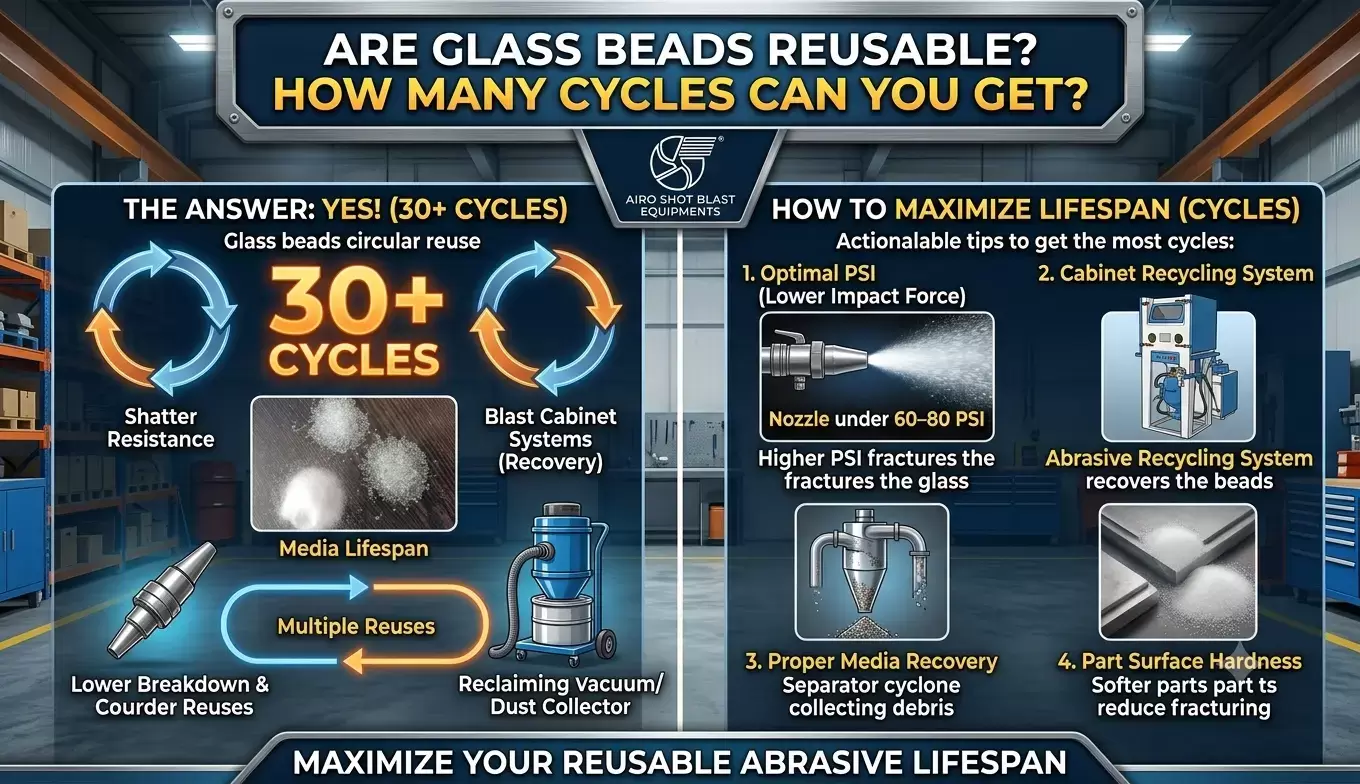
Glass beads can often be recycled through suitable blasting systems. Proper media separation, inspection, and replacement help maintain consistent processing performance.
4. Important Glass Bead Specifications for Shot Peening
Selecting the correct glass bead specifications is essential for achieving the required surface treatment.
The following factors should be considered before choosing glass bead media.
- Glass Bead Size: Glass bead size influences impact energy, indentation characteristics, and surface texture. The appropriate size depends on the component material and required compressive stress profile.
- Sphericity: Consistent spherical particles help produce more predictable impact conditions. Broken or irregular particles can create unwanted surface effects.
- Hardness: Glass bead hardness influences impact behaviour and media durability. It should be suitable for the component material and intended treatment.
- Particle Size Distribution: A controlled size distribution supports repeatable process performance and consistent coverage.
- Media Cleanliness: Contaminated glass beads can negatively affect surface quality. Clean, properly screened media should be used for critical applications.
For demanding shot peening applications, manufacturers should follow a qualified process specification rather than selecting media based on particle size alone.
5. Applications of Glass Bead Shot Peening
Glass bead shot peening is used in various industrial sectors where surface condition and component durability are important.
Automotive Industry
Selected automotive components, brackets, housings, and precision metal parts may undergo shot peening to improve their resistance to repeated mechanical loading.
Aerospace Industry
Aircraft components operate under demanding conditions involving repeated stress cycles. Carefully controlled peening processes may be used on selected components to improve fatigue performance.
Engineering and Manufacturing
Industrial machinery, precision components, and mechanical assemblies can benefit from appropriate surface treatment processes.
Stainless Steel Components
Glass bead treatment is used on selected stainless steel components to achieve a uniform surface appearance and controlled surface condition. However, decorative glass bead blasting and fatigue-oriented shot peening are different processes and should not be treated as interchangeable.
Medical Equipment Manufacturing
Certain metal components and instruments may undergo specialized surface finishing operations where controlled texture and surface quality are important.
6. Glass Bead Shot Peening vs. Steel Shot Peening
Both glass beads and steel shots are used in mechanical surface treatment, but they have different physical properties and applications.
| Comparison Factor | Glass Beads | Steel Shot |
|---|---|---|
| Material | Spherical glass | Steel |
| Density | Lower | Higher |
| Impact energy | Generally lower at comparable velocity and size | Generally higher |
| Surface effect | Controlled, relatively gentle impact | Stronger impact potential |
| Surface appearance | Often uniform and matte | Depends on media and process |
| Common applications | Finishing and selected peening applications | Industrial shot peening |
The best media depends on the required compressive stress, component material, fatigue performance target, and applicable industry specification.
Steel shot is commonly selected for demanding fatigue-critical applications because of its higher density and impact energy. Glass beads may be appropriate for specific lower-intensity or specialized peening applications.
7. Best Practices for Achieving Effective Shot Peening Results
To obtain reliable results from glass bead shot peening, manufacturers should maintain strict process control.
- Select the Correct Media: Choose glass beads based on the component material, required surface condition, and process specification.
- Control Blasting Pressure: Maintain consistent pressure and particle velocity to achieve repeatable impact conditions.
- Maintain Proper Coverage: Ensure that the entire specified surface receives adequate and uniform treatment.
- Monitor Media Condition: Regularly inspect glass beads for breakage, contamination, and changes in particle size distribution.
- Use Appropriate Equipment: Select blasting equipment that provides controlled media flow, pressure, and nozzle positioning.
- Verify Surface Quality: Inspect components for excessive roughness, visible damage, and other unwanted surface changes.
- Measure Peening Intensity: Use appropriate methods such as Almen strip testing where applicable to verify process intensity and repeatability.
For fatigue-critical applications, residual stress measurements and fatigue testing may also be required to confirm performance.
8. How to Choose a Reliable Glass Bead Supplier
Choosing a dependable glass bead manufacturer or supplier is important for maintaining consistent shot peening results.
Before purchasing, evaluate:
- Availability of different glass bead sizes and grades.
- Consistency of particle shape and size distribution.
- Product technical data sheets.
- Quality inspection and testing facilities.
- Bulk supply capacity.
- Packaging and storage standards.
- Technical support for industrial applications.
A reliable supplier should be able to provide clear product specifications and help identify suitable glass bead grades for your intended process.
Conclusion
Glass beads for shot peening offer a controlled surface treatment option for selected metal components. By creating localized plastic deformation and beneficial compressive residual stresses, properly controlled peening can help improve resistance to fatigue crack initiation and extend component service life.
However, achieving reliable fatigue improvement requires more than simply blasting a metal surface. Correct media selection, impact intensity, coverage, process monitoring, and performance validation are essential.
We are a trusted manufacturer and supplier of premium-quality glass beads, offering a complete range of glass bead blasting media, large glass beads, micro glass beads, glass shot peening beads, solid glass beads, reflective glass beads, glass bead beading, road marking glass beads, decorative glass beads, industrial glass beads, and abrasive glass beads in various types, grades, mesh sizes, and specifications. Our glass beads are widely used for abrasive blasting, shot peening, surface cleaning, deburring, polishing, stainless steel finishing, road marking, reflective applications, and industrial surface treatment. We provide quality glass bead solutions to meet diverse industrial requirements.
Whether used in automotive manufacturing, aerospace engineering, or precision component production, understanding the role of glass bead shot peening helps manufacturers make informed decisions about surface treatment and component durability.